
Venice AI and VVV: Valuing a Burn Stream
A Blue Coin Capital research primer. Data as of September 16, 2026. Figures marked "company-reported" have not been independently audited. Disclosure at the end.
Privacy Got a Price
In early September, an NYU mathematician named Tristan Buckmaster publicly questioned whether OpenAI had benefited from his unpublished work on the Navier-Stokes equations, one of the great open problems in mathematics. He had fed his draft into OpenAI’s Codex while working on the proof. OpenAI denied that its researchers accessed his data, but acknowledged it could not rule out that de-identified conversation data contributed to model improvements.
That phrase, “could not rule out,” did the damage. Within days, a simple question spread across the industry: can the things you type into an AI chatbot end up informing someone else’s work? For most users the question is abstract. For anyone whose prompts contain unpublished research, deal terms, patient information, or legal strategy, it is not abstract at all.
The market reacted in an unusual place. VVV, the token attached to Venice AI, a privacy-first inference platform, jumped roughly 40 percent that week and printed a new all-time high above $27. The narrative was clean: if private AI has value, the leading private AI platform should capture it.
We think the narrative is half right. Venice the business is real, growing fast, and well positioned in a niche that just received a public demonstration of why it exists. But VVV the token is not equity in Venice, and the difference between the two is where almost all of the analytical work belongs. This primer walks through the business, the token design, and a valuation framework built around the one cash flow VVV holders actually receive: token burns.
What Venice Is
Venice AI is a private, uncensored AI platform founded in 2024 by Erik Voorhees, one of crypto’s earliest entrepreneurs and the founder of ShapeShift. The product gives users access to more than 230 models through one interface and API: Venice’s own uncensored open-source lineup, plus every major frontier model (GPT, Claude, Gemini, Grok) proxied through Venice with the user’s identity stripped.
The privacy claim rests on architecture rather than policy. Conversations are stored on the user’s device, not Venice’s servers. Requests pass through Venice’s proxy without prompt content being logged. At the top of the range, Venice offers hardware-attested TEE inference (the model runs inside a secure enclave that even the GPU operator cannot inspect) and end-to-end encrypted inference, where Venice’s own infrastructure only ever sees ciphertext. Users select the privacy mode per request. No competitor currently packages all of these tiers, uncensored model access, and crypto-native payments in a single consumer product, though plenty of competitors are attacking individual pieces of the bundle.
The business model is conventional even if the product is not. A free tier with daily limits, then paid subscriptions at $18, $68, and $200 per month, plus a metered credits system (one credit equals one cent) for heavy usage, premium models, and the API. Venice reached profitability in the first quarter of 2026 without outside capital, then raised a $65 million Series A at a $1 billion valuation in July, led by Dragonfly with participation from Coinbase Ventures and others. Company-reported metrics as of mid-August: more than 4 million registered users, roughly $100 million in annualized revenue, and daily inference throughput that has grown from about 40 billion tokens per day in April to roughly 250 billion now.
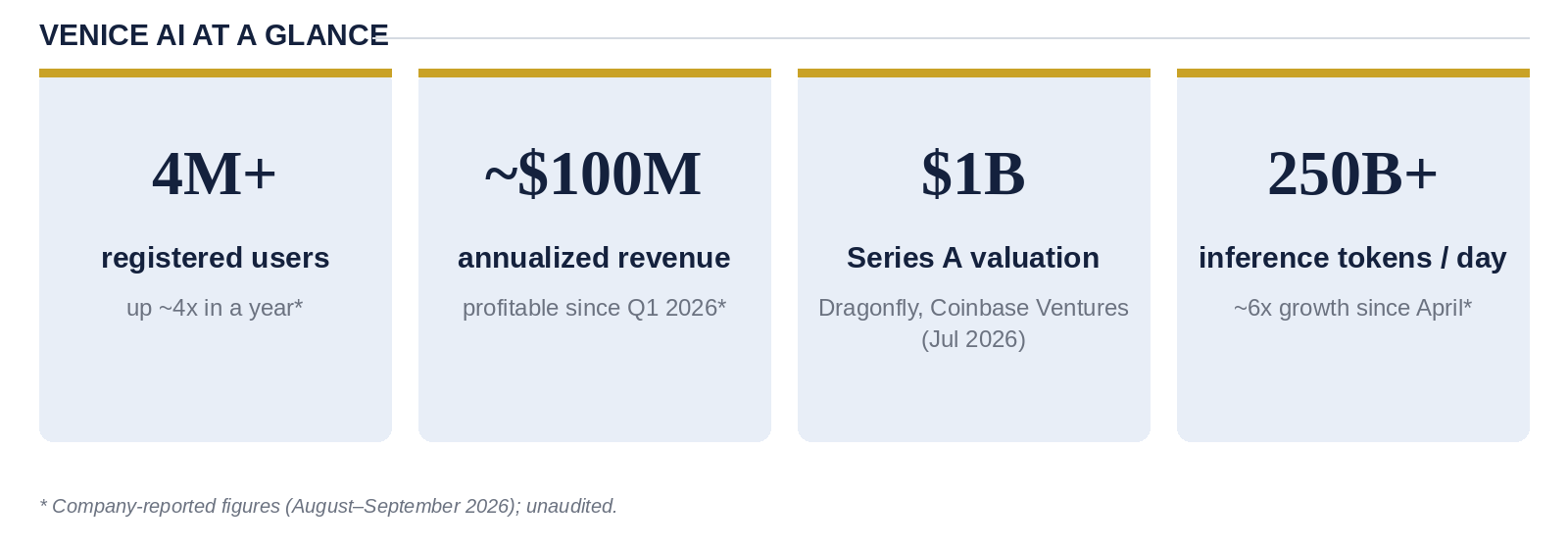
We want to be precise about what is verifiable here. The token mechanics discussed below are on-chain and checkable by anyone. The revenue, user, and throughput figures are company-reported, with no audit and no published financial statements. The trajectory is consistent across multiple independent derivations from public signup data, which gives us some comfort, but “consistent with” is not “confirmed.” That gap runs through everything that follows and it should affect the price of the token, not just the footnotes.
The Two-Token Machine
Venice runs a two-token design that separates the capital claim from the consumption claim.
VVV is the capital side. It launched in January 2025 as a fair launch: roughly half the 100 million genesis supply airdropped to users and crypto communities, no presale, no VC allocation. Staking VVV grants a share of Venice’s API inference capacity, so heavy API users can own their compute rather than rent it, and stakers receive the token’s emissions as yield. Holding 100 VVV also unlocks the Pro subscription as an ownership perk.
DIEM is the consumption side. Each DIEM is a perpetual claim on one dollar of Venice API inference per day, refreshing daily, forever. DIEM is minted by locking staked VVV at an algorithmic rate that rises steeply as supply approaches a target tied to Venice’s actual compute capacity, so issuance is governed by infrastructure rather than by management’s mood. The practical logic of the split: a fluctuating pro-rata share is a poor budgeting unit, but a dollar a day is something a developer or an AI agent can build against. One token prices the platform’s growth. The other prices compute with a fixed unit.
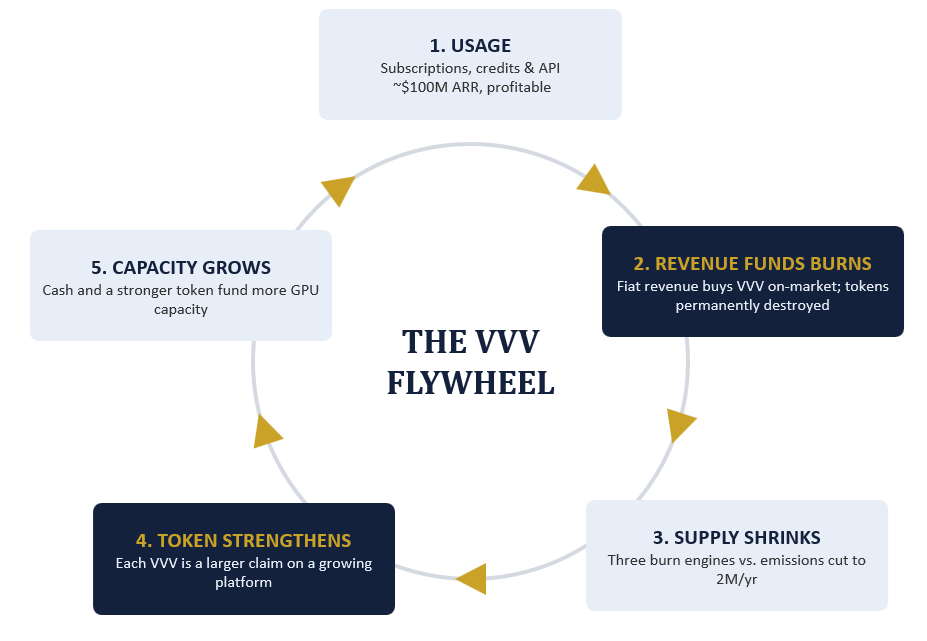
The piece that connects the token to the business is the burn program. Venice takes a slice of its fiat revenue, buys VVV on the open market, and sends it to a dead address. Permanently destroyed, verifiable on-chain. Three engines run today:
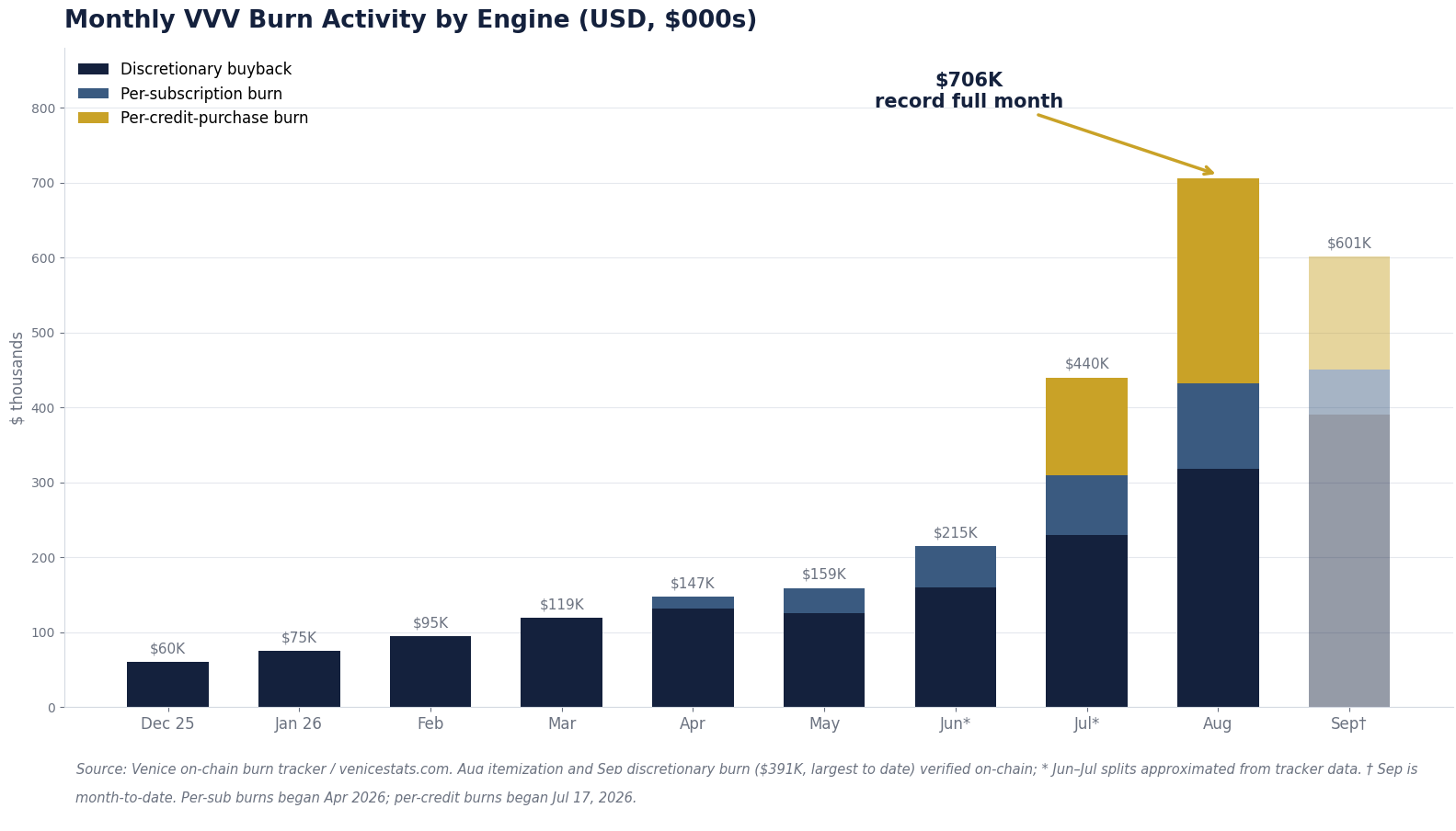
A discretionary monthly buyback funded by revenue, executed via a time-weighted program, running and escalating since late 2025.
An automatic burn of $2, $5, or $10 of VVV for every new subscription, by tier.
An automatic burn of $5 for every $100 of credits purchased.
August’s total came to roughly $706,000 burned, about $8.5 million annualized, and the monthly trend has been rising steeply. Meanwhile emissions, the token’s inflation, have been cut repeatedly, from 14 million VVV per year at launch to 2.5 million as of September 1, with a further cut to 2 million scheduled for October 1. About 42 percent of the genesis supply has already been destroyed, most of it in a one-time burn of unclaimed airdrop tokens. Management’s stated goal is a net-deflationary VVV.
The Valuation Problem
Here is the uncomfortable part, and the reason this primer exists. VVV pays no dividend. It carries no governance rights. It has no legal claim on Venice’s revenue, profits, or equity, and it sits nowhere in any liquidation waterfall. If Venice were sold tomorrow, token holders would have no enforceable claim on the proceeds.
A common framing in crypto research treats tokens like VVV as pseudo-equity: divide the market cap by platform revenue, compare the multiple to AI-company comps, and conclude the token is cheap. On that lens VVV looks attractive. Roughly $1.2 billion of circulating market value against $100 million of claimed revenue is about 12 times sales, a fraction of what AI application companies command in private markets.
We reject that framing, and the reason is what we call the claim gap. A revenue multiple prices a claim on revenue. Equity holders own the cash flows, vote on their distribution, and stand in line if things go wrong. VVV holders own none of that. What they own is the slice of revenue that management chooses to route through the burn address, currently about 8 percent, at pure discretion. Priced against the cash actually reaching holders, 12 times revenue is closer to 150 times. The pseudo-equity lens does not just flatter the token, it prices a claim that does not exist.
So we value what holders actually receive. Burns are economically identical to share buybacks: cash leaves the business, tokens are retired, and every remaining token’s claim on the future grows. Since burns are the only cash-like return VVV holders get, the fundamental value of the token is the present value of all future burn spending. Everything else is narrative.
What yield do you demand from a voluntary, unaudited, founder-discretionary stream of buybacks?
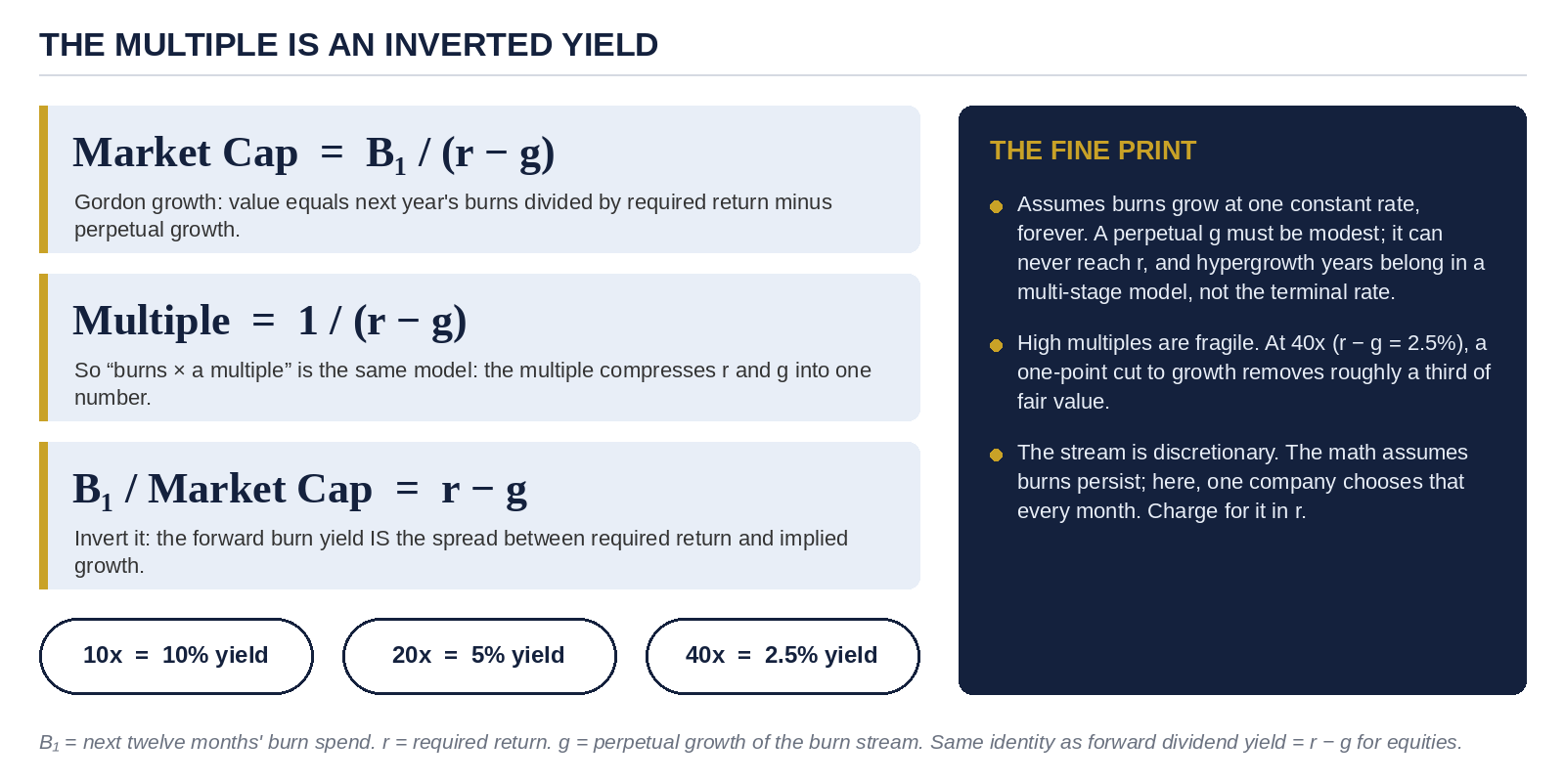
And just as with equities, an infinite stream collapses into a usable shorthand: annual burns times a multiple, divided by tokens outstanding. The multiple is an inverted yield. Twenty times burns means you are accepting a 5 percent buyback yield. Ten times means 10 percent. In Gordon growth terms, the multiple equals one divided by the discount rate minus the growth rate, so the entire argument about what VVV is worth reduces to one question: what yield do you demand from a stream of buybacks that is voluntary, unaudited, and entirely at one founder’s discretion? Nothing forces Venice to burn a single token next year. That risk has a price, and the multiple is where you charge it.
What Markets Pay for Burn Streams
We did not want to pick a multiple out of thin air, so we anchored to what markets actually pay for the three most prominent burn and buyback streams in crypto.
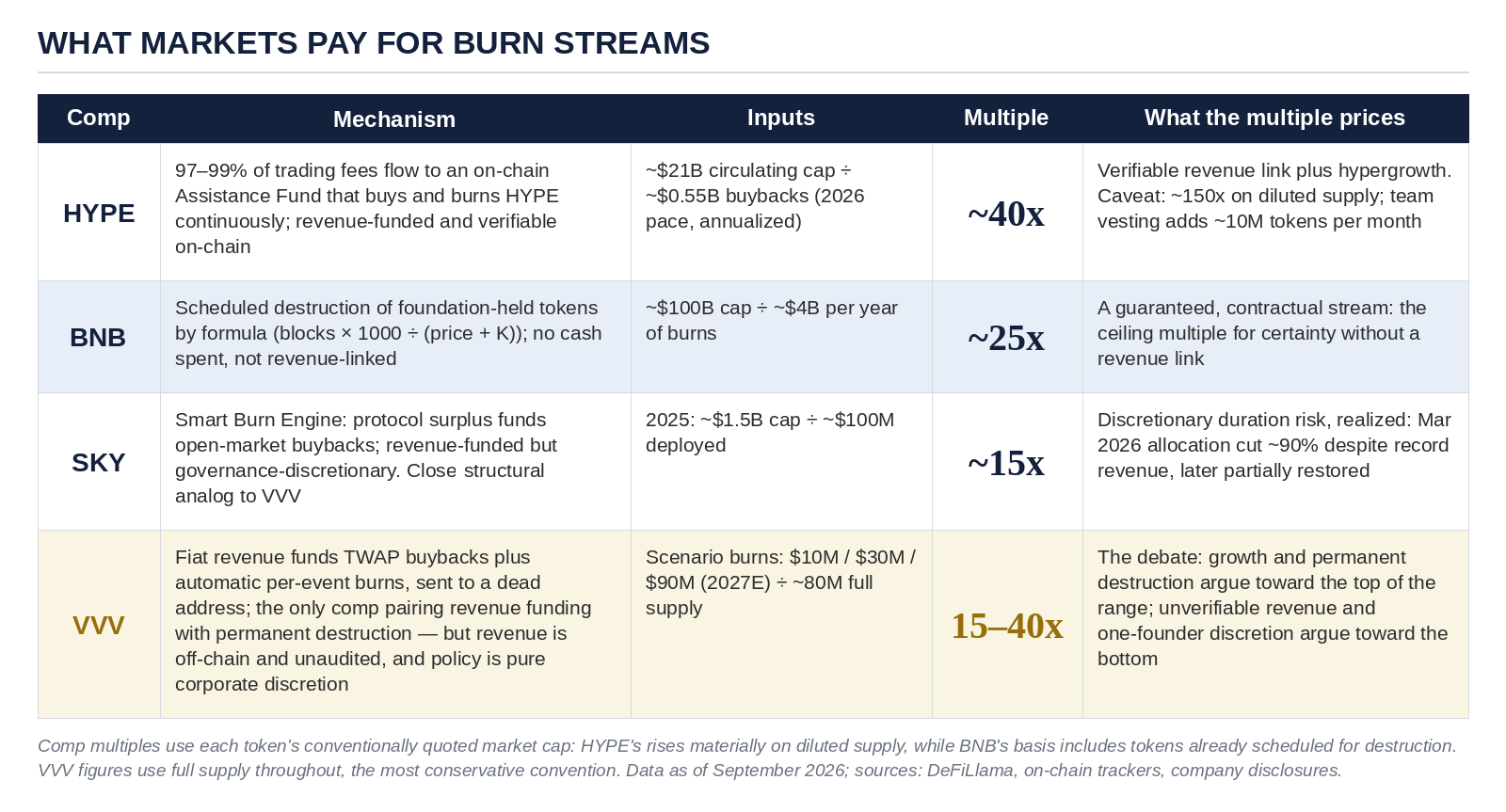
Hyperliquid (HYPE) routes 97 to 99 percent of its trading fees into a fund that buys and burns HYPE continuously. On this year’s pace, roughly half a billion dollars of buybacks against about $21 billion of circulating market cap: roughly 40 times. That is the price of a verifiable, on-chain revenue link attached to hypergrowth. It comes with caveats. On fully diluted supply the multiple is closer to 150 times, and team vesting adds roughly 10 million tokens a month to the float, several times what the buyback removes.
BNB destroys tokens on a quarterly schedule, roughly $4 billion a year against a $100 billion market cap: about 25 times. But read the mechanism. Those burns are formula-driven destruction of foundation-held tokens. No cash is spent and nothing is bought on-market. The stream is guaranteed, which earns a premium multiple, but it is not linked to revenue at all.
Sky (formerly Maker) is a close structural cousin to Venice: protocol surplus funding open-market buybacks. It trades around 15 times, and it is also the cautionary tale. In March 2026, governance cut the buyback allocation by nearly 90 percent despite record quarterly revenue, choosing reserves over distributions. The token fell on the news with the best fundamentals in its history. The allocation has since been partially restored, but the lesson stands: a discretionary stream carries duration risk that a scheduled one does not, and the market reprices that risk instantly when it materializes.
So the observed range for burn streams is roughly 15 to 40 times, and where VVV deserves to sit inside it is the whole debate. In VVV’s favor: it is the only one of these doing revenue-funded open-market purchases with permanent destruction, the strongest possible plumbing. Against it: the revenue behind the stream is off-chain and unaudited, and the policy is pure corporate discretion, with no governance process and no recourse for holders. Strongest destination, weakest assurance the water keeps flowing.
The Build and the Scenarios
Our base case builds burns from the bottom up, using the company’s claimed revenue trajectory and the published burn triggers.
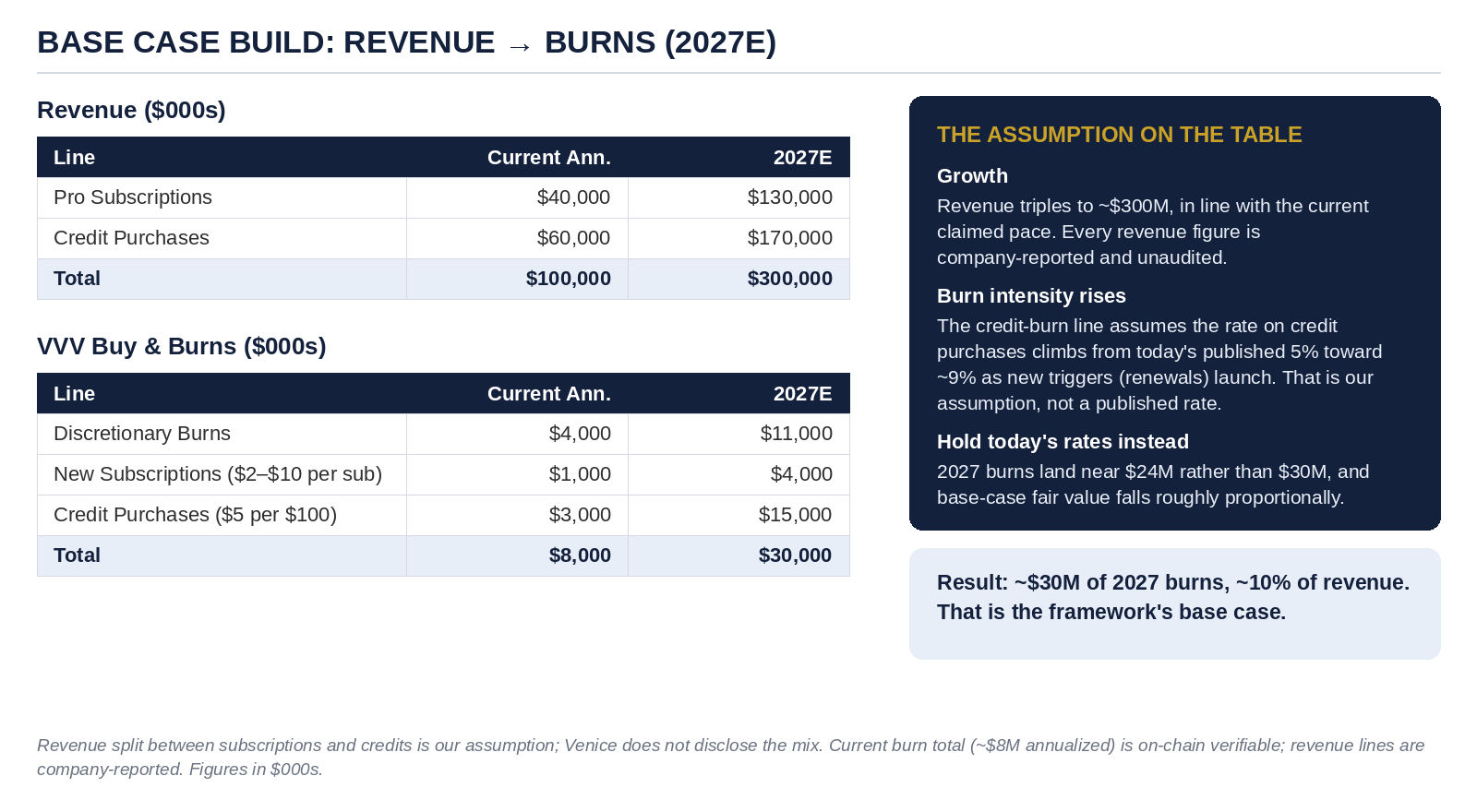
Annualized revenue of roughly $100 million today, split between subscriptions and credits (the split is our assumption; Venice does not disclose the mix), growing at roughly the current claimed pace to about $300 million in 2027. Burns of roughly $8 million today, growing to about $30 million in 2027 across the three engines. One assumption deserves the table rather than the footnotes: our credit-burn line assumes the burn rate on credit purchases rises from today’s published 5 percent toward roughly 9 percent. Management has signaled that new burn triggers are coming, subscription renewals being the obvious candidate, so rising burn intensity is a reasonable expectation. But it is an assumption, not a published rate. Hold today’s rates and 2027 burns land closer to $24 million.
From there, three scenarios. We stress that these are illustrative valuation ranges, not price targets.
The bear case: growth stalls near $150 million as the privacy niche saturates the way privacy niches historically have. DuckDuckGo spent fourteen years building an excellent free product and converted roughly 2.5 percent of its home market. Brave sits at one to two percent of browsing after a decade. In that world, discretionary burns get cut first, exactly as Sky demonstrated, and burn intensity falls to around 7 percent, roughly $10 million. At 15 to 20 times, strict burn math supports something around $2 per token. We would note that actual trading value in a bear case would likely sit above that floor on residual utility (staking for API access, the Pro perk) and the option that management restarts value accrual. But that is the level the cash flows support, and the distance between it and the current price is the risk in this token.
The base case: growth is real but decelerates, revenue reaches roughly $300 million, and burns stay at what we would call credibility level, about $30 million at 10 percent intensity. At 25 to 30 times, roughly $9 to $11 per token.
The bull case: the 3x growth pace accelarates, revenue clears $450 million, management shifts from reinvestment toward harvest, renewal burns launch, and the token goes net-deflationary as promised. Roughly $90 million of burns at 30 to 40 times: $34 to $45 per token.
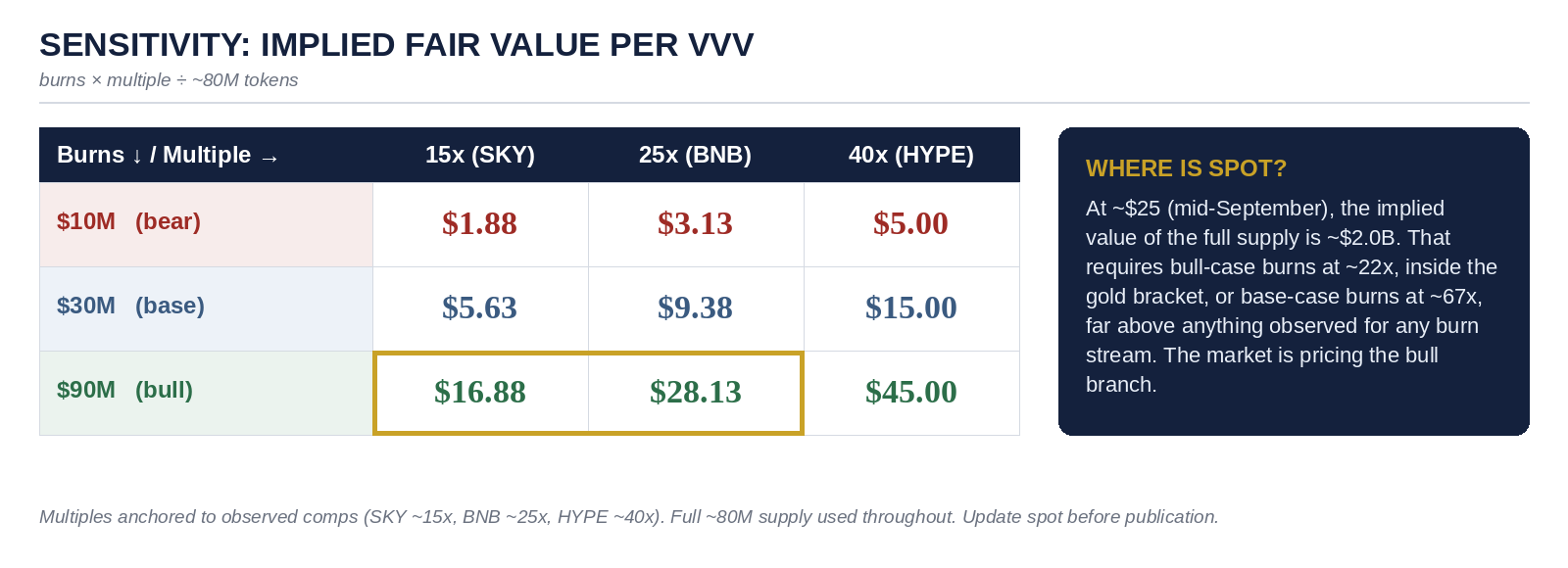
Now place the market price on that map. VVV trades around $25 as we write. Against roughly 80 million tokens, that implies a value near $2 billion, which requires the bull case’s $90 million of burns at about 22 times, or the base case’s burns at a multiple far above anything observed for any burn stream anywhere. Put plainly: at today’s price, the market is no longer paying you to underwrite the base case. It is paying for a substantial portion of the bull case, on burns eleven times larger than the ones running today, funded by revenue nobody outside the company has audited.
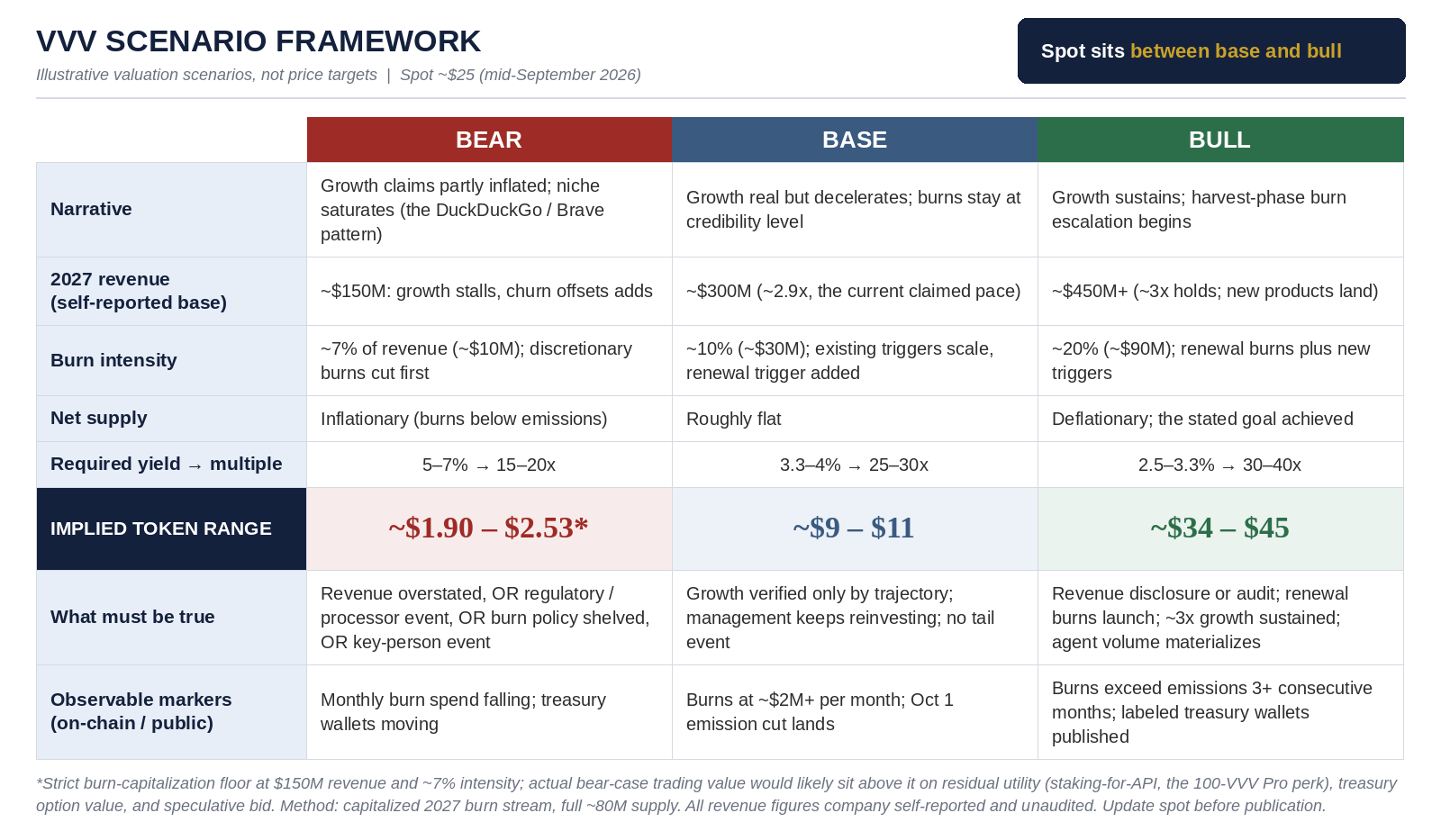
We do not think that makes the token uninvestable. We think it makes the position a specific bet: that self-reported growth is real, and that management keeps choosing to point an increasing share of it at the burn address. Both halves of that bet deserve scrutiny, which brings us to governance.
Risks and the Governance Question
The risk section of most token research is a list. Ours is mostly one question: what happens when the interests of the company and the interests of the token diverge?
Start with what is structurally unusual. Venice was self-funded to profitability, so for most of its life there was no VC preference stack competing with the token for economic priority. The July Series A changed that: there is now roughly $1 billion of equity whose return runs through the company, not the token. Every dollar of revenue routed to burns is a dollar not reinvested or retained for equity. Today the burn program runs at roughly 8 percent of claimed revenue, which is to say the company is still prioritizing reinvestment over distribution. The bull case requires that policy to reverse at exactly the moment the business matures.
The counterweight is an alignment argument we find genuinely interesting: the token may be the only viable exit. Venice’s uncensored posture, its deliberately limited ability to see user content, and its founder’s regulatory history make a strategic acquisition or a conventional IPO difficult to imagine. The equity, in other words, may have no liquidity event. The token trades on Coinbase every day. Insiders hold roughly 30 million VVV between the treasury and team allocations, which makes VVV functionally the public listing of Venice and the primary channel through which insider wealth can ever be realized. That is a structural reason to believe management keeps supporting the token, and it is sturdier than goodwill. But it is double-edged by construction: the same fact that guarantees management cares about VVV’s price makes them its eventual sellers, and there is no published vesting schedule or labeled treasury constraining when or how. Holders are buying alignment with insiders on the way up and providing their liquidity at the top. Whether the ride justifies the destination is the actual investment question.
We would also weigh the observed record. Management has cut emissions six times, escalated burns every quarter they have existed, and burned tens of millions of tokens it could have kept, including an unclaimed-airdrop tranche worth nine figures at today’s prices. The founder’s public identity is inseparable from the claim that this token treats its holders fairly, and fifteen years of that reputation is posted as collateral. None of this is enforceable, which is the point of our framework. But pricing the stream’s discretion risk without acknowledging that the discretion has, so far, been exercised consistently in holders’ favor would be its own kind of error.
The remaining risks, briefly. Everything upstream of the burns is unverifiable: revenue, users, throughput, and the capacity figures that govern DIEM issuance are company statements, and the entire framework above inherits that uncertainty. Control is concentrated: on-chain authority sits with a small multisig, token-holder governance described in the documentation is not deployed, and the burn policy can change in an afternoon. The content posture that creates the moat also creates the tail: platforms built on “we cannot see what users do” sit poorly with the direction of UK and EU regulation, and payment processors have cut off businesses for less. And the competition is real on every front: hardware-attested inference specialists, consumer encrypted-chat products, privacy modes bolted onto mainstream models, and infrastructure partners who can become rivals. Venice’s TEE mode runs on a partner that sells the same guarantee directly. The defensible asset is the bundle and the brand, not the plumbing.
What We Are Watching
The virtue of a burn-capitalization framework is that it is checkable in real time. The inputs are on-chain, and the scenarios above come with markers that either happen or do not. Here is the scoreboard as of publication.
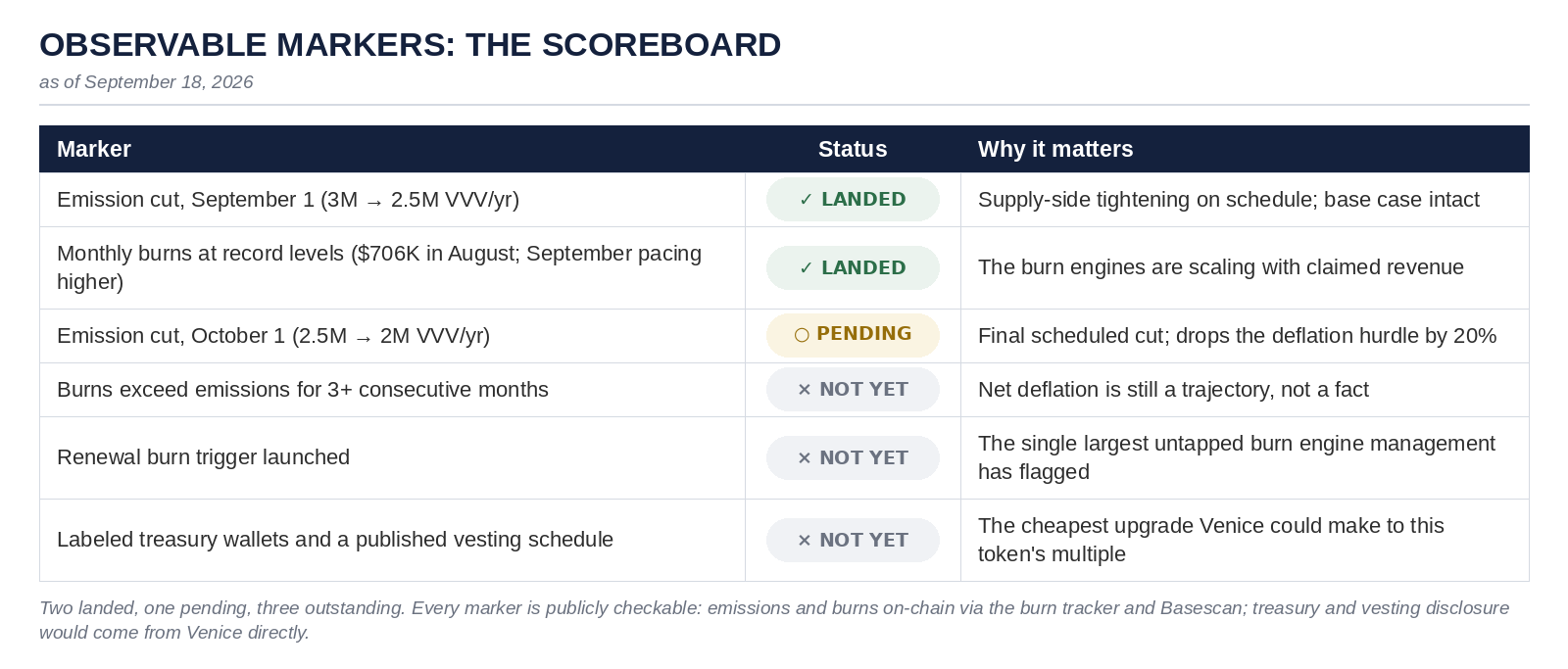
The September 1 emission cut landed on schedule. Monthly burn spend set a record in August and appears to be rising again in September. DIEM’s capacity target expanded on schedule in mid-September, consistent with growing infrastructure. Those are base-case-and-better markers resolving in the right direction.
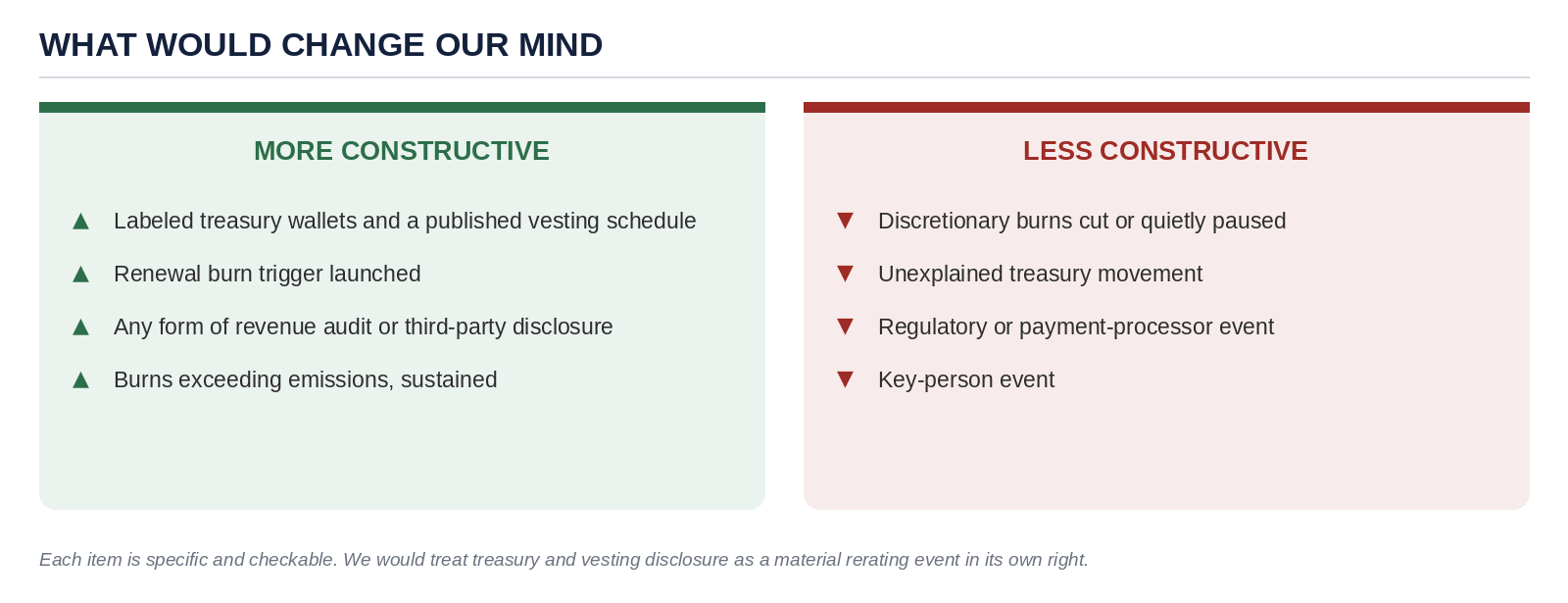
What has not happened matters just as much. Burns still cover only a fraction of emissions, so the deflation story remains a trajectory rather than a fact. The renewal burn trigger management has discussed has not launched. And the single cheapest upgrade Venice could make to this token’s multiple, publishing labeled treasury wallets and a vesting schedule, remains undone. If it happens, we would treat it as a material rerating event. If treasury tokens start moving without explanation, we would treat that as material in the other direction.
Bottom Line
Venice is one of the most interesting businesses in crypto: a genuinely differentiated product, a demand driver that current events keep validating, claimed growth that independent reconstructions keep corroborating, and a token design that links platform revenue to holders through the strongest burn plumbing in the market. We hold it, and we are constructive on the business.
But the framework exists precisely so that enthusiasm for a business does not become hype. VVV is a discretionary, junior, unaudited claim, and at roughly $25 the market is pricing most of the bull branch: eleven times today’s burns, at multiples near the top of anything observed, on numbers nobody outside the company can verify. The honest summary is that we own a position sized for that asymmetry, we would get more constructive on the specific, checkable events listed above, and we would rather track a falsifiable scoreboard than argue about narratives. The arithmetic is all here. Turn the cranks yourself.
If you encounter a paywall on any of the linked resources, feel free to reach out—I’d be happy to share the full content.
If you found this newsletter valuable, please consider sharing it with others.
Mike Treidl, CFA | Founder & CIO @ Blue Coin Capital
Sources and further reading: venice.ai and Erik Voorhees’ public posts, venicestats.com, Delphi Digital’s Venice research, Austin Barrack’s commentary, Bankless X Spaces, on-chain data via Basescan and DeFiLlama, Messari’s Venice project coverage, and press coverage of Venice’s Series A. These served as general background and useful sources of information.
Disclosures & Disclaimers
The information contained in this newsletter is for informational purposes only and does not constitute investment, legal, or tax advice. Blue Coin Capital is an investment adviser that manages digital asset strategies for qualified investors. Nothing herein should be interpreted as an offer to sell, or a solicitation of an offer to buy, any securities or investment products.
Blue Coin Fund LP holds a position in VVV. Opinions expressed are current as of the date of publication and subject to change without notice. Certain content may reflect the views of Blue Coin Capital and its personnel and may include forward-looking statements that are not guarantees of future performance.
Digital assets, including cryptocurrencies and stablecoins, are speculative and involve a high degree of risk. Past performance is not indicative of future results. Always conduct your own research and consult with a qualified professional before making any investment decisions.
Blue Coin Capital, LLC is a California limited liability company.

